
Practical Guides
Japan's New Tourist Taxes and Fees in 2026
The departure tax triples, Kyoto's accommodation tax now scales with room price, and tax-free shopping changes how refunds work. What actually changed in 2026.
2 min
実用
Japan's reputation as a cash-only country is badly out of date — but so is assuming your card works everywhere. Here is the actual state of paying for things in Japan.

"Japan is a cash society, bring lots of yen" is the single most repeated piece of advice about travelling there, and it is now mostly wrong. It is also not entirely wrong, which is what makes it annoying.
Japan's Ministry of Economy, Trade and Industry tracks the share of consumer spending that happens without cash. By METI's 2025 figures, cashless payments accounted for 58% of consumer spending, worth a record ¥162.7 trillion. The government's earlier target of 40% was passed comfortably; the current goals are 65% by 2030 and 80% in the longer term.
Within that cashless share, credit cards do most of the heavy lifting at around 83% of the value. QR code payments — PayPay and its rivals — account for roughly 10% and are the fastest-growing category, with electronic money and debit cards making up the rest.
For a country still routinely described as allergic to plastic, that is a fairly ordinary set of numbers.
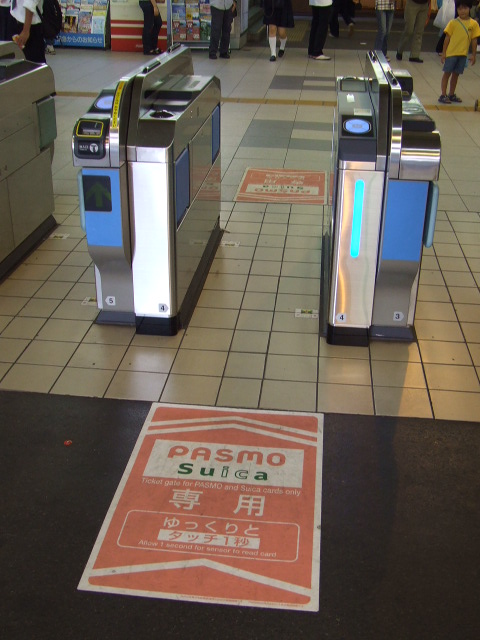 IC card–only gates. Tap in, tap out, no fare calculation required.
IC cards are the real answer. Suica, PASMO, ICOCA and their regional siblings started as train passes and quietly became a general-purpose wallet. They work on trains, buses, in convenience stores, at vending machines, in coin lockers, and in a large share of chain restaurants and shops. Most travellers can now add one directly to an iPhone or Android wallet without buying a physical card at all.
 Top-up machines take coins and notes up to ¥10,000 and are in essentially every station.
Credit cards work in hotels, department stores, chain restaurants, and larger shops without any drama. Visa and Mastercard are near-universal; Amex and Discover are patchier.
QR payments like PayPay are everywhere in local shops, but most require a Japanese phone number or bank account to set up, which puts them out of reach for most short-term visitors.
This is the part the "Japan is cashless now" articles skip.
Carry roughly ¥10,000–20,000 in cash as a working float, put an IC card on your phone, and bring one Visa or Mastercard. That combination covers essentially everything.
For cash withdrawals, 7-Eleven ATMs and Japan Post Bank ATMs reliably accept foreign cards; many bank ATMs do not, and some close overnight. Since 7-Eleven alone runs over 21,000 stores in Japan, this is rarely inconvenient.
One last thing: even in cashless transactions, Japan retains the small tray on the counter. Put your card or cash in the tray rather than handing it over directly — it is a small courtesy that is still standard nearly everywhere, and it is the kind of thing that separates visitors who have paid attention from those who have not.
動画で見る
Watch the related Japan Off Script episode
購読
New guides on Japanese culture, food and travel. No spam, unsubscribe any time.
コメント
関連記事
Practical Guides
The departure tax triples, Kyoto's accommodation tax now scales with room price, and tax-free shopping changes how refunds work. What actually changed in 2026.

Practical Guides
Bring a big suitcase on the Tokaido, Sanyo, or Kyushu Shinkansen without the free reservation, and staff can charge you ¥1,000 on the spot. Here's the actual rule.

Practical Guides
The JR Pass went from a no-brainer to a genuine calculation. Here is the break-even point for every common route, and the four itineraries where it still wins.